IELTS vs TOEFL vs Duolingo English Test: Which One Should You Take?
Compare IELTS, TOEFL and the Duolingo English Test: format, speaking section, scoring, who usually accepts each one, and how to prepare for the test you choose.
Published 6 min read
In this article
The right English test depends on who will receive your score. IELTS and TOEFL are long-established exams accepted by many universities around the world, and IELTS is also widely used for visa and immigration applications. The Duolingo English Test is shorter, taken online at home and usually cheaper; a growing number of universities accept it, but it's less often accepted for visas. Always check what your university, employer or government office asks for before you book.
In short: find the exact English requirement of the place you're applying to, then choose between IELTS, TOEFL and the DET based on what's accepted, which format suits you, and where you can take it.
Start with one question: who needs your score?
People often ask which test is "best", but the useful question is which test your destination accepts. Find the English language requirements page of the university, programme, employer or immigration authority. It usually tells you:
- Which tests are accepted, sometimes a specific version (for example IELTS Academic rather than General Training).
- The minimum overall score, and sometimes a minimum for each skill.
- How recent your result must be.
If more than one test is accepted, then compare the format, the fee in your country and the dates available near you.
IELTS at a glance
IELTS (International English Language Testing System) is jointly owned by the British Council, IDP IELTS and Cambridge University Press & Assessment.
- Two main versions: IELTS Academic, for university study and some professional registration, and IELTS General Training, often used for work and migration.
- Four parts: Listening, Reading, Writing and Speaking.
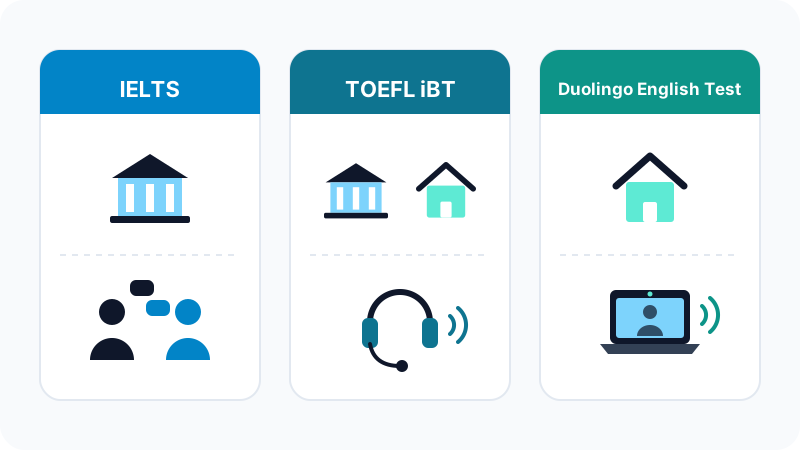
- Speaking is a face-to-face conversation with a trained examiner, not a recording. It's sometimes held on a different day from the other parts.
- Where: mostly at official test centres, on paper or on computer. An online version is offered in some countries.
- Scores: each skill gets a band from 0 to 9, including half bands, and you get an overall band.
There is also a separate version for UK visa applications, IELTS for UKVI. If you need a UK visa, check the UK government's official website for the approved tests before booking anything.
TOEFL iBT at a glance
TOEFL is run by ETS, a US-based testing organisation. Its main version, TOEFL iBT, focuses on academic English, the kind you hear in lectures and read in course materials.
- Four skills: Reading, Listening, Speaking and Writing, all taken on a computer.
- Speaking: you answer tasks into a microphone and your recordings are scored afterwards. There's no live examiner.
- Where: at a test centre, or at home where the at-home option is available.
- Scores: TOEFL iBT has long reported a total score from 0 to 120. ETS has recently updated the test format and the way scores are reported, so read the current details on the official ETS website.
TOEFL is especially well known among universities in the United States, and many institutions in other countries accept it too.
Duolingo English Test at a glance
The Duolingo English Test (DET) is an online test from Duolingo, the company behind the language-learning app.
- Where: at home on your own computer, with your camera and microphone on. There are strict rules about your room, your screen and what's on your desk.
- Adaptive: questions get harder or easier depending on your answers, which keeps the test short, about an hour.
- Question types: many short, varied tasks that mix skills, such as completing missing letters in a text, typing what you hear, reading aloud, and speaking or writing about a prompt.
- Scores: an overall score on a scale from 10 to 160, plus subscores. Results usually arrive within a few days.
- Samples for institutions: at the end you record a short speaking sample and write a short writing sample. They aren't part of your score, but institutions that receive your results can view them.
Many universities accept the DET, but it's accepted less often for visas and professional registration, so confirm before you choose it.
Side-by-side comparison
| IELTS | TOEFL iBT | Duolingo English Test | |
|---|---|---|---|
| Run by | British Council, IDP, Cambridge | ETS | Duolingo |
| Where | Test centre (online in some countries) | Test centre or at home | Online, at home |
| Speaking | Live examiner | Recorded into a microphone | Recorded on your computer |
| Score scale | Bands 0 to 9 | Check the current scale on the ETS site | 10 to 160 |
| Length | Just under 3 hours | Depends on the current format | About 1 hour |
| Commonly used for | Study, work and migration | Study, especially in the US | University admission |
| Fee | Check the official site | Check the official site | Usually the lowest of the three |
Which test fits your goal?
- University in the UK, Australia, Canada or New Zealand: IELTS Academic is very widely accepted. Many universities also accept TOEFL, and some accept the DET. Check each programme separately.
- University in the United States: TOEFL and IELTS are both widely accepted, and many US universities also accept the DET.
- Visa or immigration: governments publish strict lists of accepted tests and versions, and these lists change. Confirm on the official government website only, not on forums or social media.
- Work or professional registration: employers and professional bodies, for example in healthcare, often set their own requirements, which can be higher than university ones.
- A quick result for an application that accepts it: the DET is shorter and taken at home, which is convenient if your destination accepts it.
How to prepare, step by step
- Learn the format. All three official websites offer free sample questions or practice material. Knowing the task types in advance saves time and nerves on the day.
- Take a timed practice test to find your starting level and your weakest skill.
- Focus on your weakest skill. For listening and reading, practise with the official task types. For writing, read the published scoring criteria and write under a time limit.
- Practise speaking out loud. Record your answers, listen back and work on clarity. Our guide to improving your English pronunciation lists free tools for this.
- Use AI for feedback, carefully. An AI assistant can suggest improvements to a practice essay or ask you speaking questions, but it doesn't grade exactly like official examiners. See how to learn a language with ChatGPT and other AI.
- Sit a full mock test a week or two before the real one, with real time limits.
- Read the test-day rules: the ID you need, what you can bring, and for home tests, the computer, camera and room requirements.
In the months before the test, daily vocabulary and listening practice helps too. Our list of the best apps to learn English is a good place to start.
Book safely and check the fee
Book only through each test's official website or an authorised test centre listed there: ielts.org, ets.org/toefl and englishtest.duolingo.com. Fees and dates vary by country and change over time, so check the current price when you book. Be very wary of anyone offering a certificate or a guaranteed score without sitting the exam. These offers are scams, and a fake result can get your application rejected. Our guide to spotting online scams covers the warning signs.
Frequently asked questions
Which is easier: IELTS, TOEFL or the Duolingo English Test?
None of them is simply easier; they test the same skills in different ways. Some people prefer talking to a real examiner in IELTS, others prefer speaking into a microphone in TOEFL, and some like the short adaptive format of the DET. Try the free official practice material for each before deciding.
How long are the results valid?
Results are only accepted for a limited time after the test, and the rules differ between tests and between institutions. Check the official test website and the requirements of the place you're applying to.
How much does each test cost?
Fees depend on the test, the version and your country, and they change over time. The Duolingo English Test is usually cheaper than IELTS and TOEFL, but check the current price on each official website before you book.
Can I take these tests at home?
The Duolingo English Test is taken online at home. TOEFL iBT offers an at-home option alongside test centres, and IELTS is mostly taken at test centres, with an online version in some countries. Home tests have strict rules about your room, computer and camera.
Related tutorials
Language learning
Best Free Translation Tools: Google Translate, DeepL, Microsoft Translator and AI
Compare Google Translate, DeepL, Microsoft Translator and AI chatbots, with tips for more accurate translations and for keeping private text safe.
· 5 min read
Language learning
How to Improve Your English Pronunciation with Free Online Tools
Improve your English pronunciation for free with dictionary audio, phonetic symbols, shadowing, recording yourself, YouGlish and AI voice practice.
· 6 min read
Language learning
Best Apps to Learn English: Free and Paid Options Compared
The best-known apps for learning English, including Duolingo, BBC Learning English, Anki and Busuu: what each does well, free vs paid, and how to combine them.
· 6 min read