Which Programming Language Should You Learn First?
Python or JavaScript? Find the best first programming language for your goal, whether that's websites, data and AI, mobile apps, or games, and how to start.
Published 5 min read
In this article
For most beginners, the best first programming language is Python or JavaScript. Choose Python if you want the easiest start or you are interested in data, automation, or AI. Choose JavaScript if your goal is to build websites and web apps. Both are free, widely used, and have huge amounts of free learning material.
In short: pick the language that matches what you want to build, stick with it for a few months, and focus on projects rather than switching languages.
Why the "best" language depends on your goal
There is no single best language. Every language was designed to be good at certain jobs. JavaScript is the language browsers run, Swift is Apple's language for iPhone apps, and Python is widely used in data science because of its libraries.
So the useful question is not "which language is best?" but "what do I want to build first?". Once you know the answer, the choice becomes much easier.
The good news: the core ideas you learn in your first language (variables, conditions, loops, functions, and how to debug) carry over to almost every other language.
Python: the friendliest place to start
Python reads almost like plain English, which makes it one of the easiest languages to learn:
name = "Sara"
for i in range(3):
    print("Hello,", name)
Why beginners like it:
- Clean syntax with very little punctuation to remember.
- Useful quickly: automate boring tasks, rename files, process spreadsheets, or scrape data.
- It is a main language for data analysis and machine learning, with libraries such as pandas, NumPy, and PyTorch.
- Also used on the backend with frameworks such as Django and Flask.
Keep in mind: Python is not the usual choice for building mobile apps or code that runs inside the browser.
Ready to try it? Our guide to Python for beginners walks you through your first program.
JavaScript: the language of the web
If you want to build websites, JavaScript is hard to avoid. It is the programming language every modern browser runs, alongside HTML for structure and CSS for style.
const name = "Sara";
for (let i = 0; i < 3; i++) {
  console.log("Hello, " + name);
}
Why it's a strong first choice:
- You can start with nothing but a browser and a text editor.
- You see your results instantly on a web page, which is motivating.
- With Node.js it also runs on servers, so one language can cover both frontend and backend.
- It opens the door to popular tools like React, and even to mobile and desktop apps through frameworks.
Keep in mind: JavaScript has some quirks that can confuse beginners, so learn the basics carefully before jumping into frameworks.
Choose by what you want to build
Here is a practical map from goal to first language:
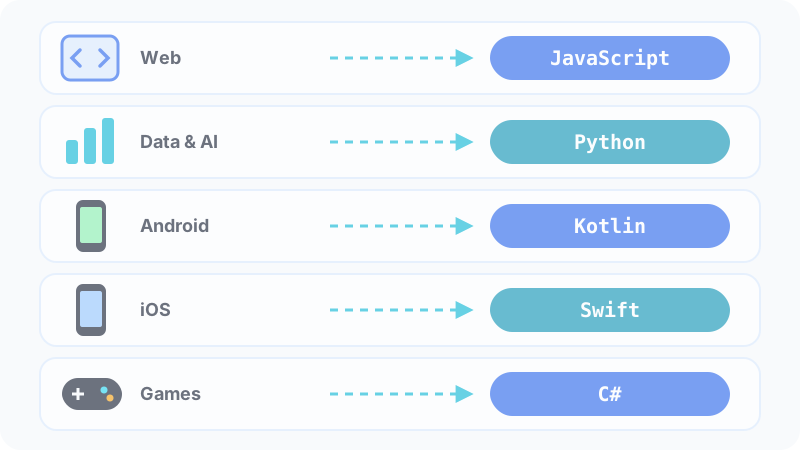
| Your goal | Good first language | Why |
|---|---|---|
| Websites and web apps | JavaScript | Runs in every browser; also works on servers with Node.js |
| Data analysis, automation, AI | Python | Simple syntax and strong data and machine learning libraries |
| Android apps | Kotlin | Google's recommended language for Android development |
| iPhone and Mac apps | Swift | Apple's modern language for its platforms |
| Games | C# | Used by the Unity game engine |
| Not sure yet | Python | The gentlest learning curve, and broadly useful |
Other languages you will hear about
- Java: long used in large companies, backend systems, and Android. Verbose but very structured.
- C#: Microsoft's language, used for Windows apps, web backends with ASP.NET Core, and Unity games.
- C and C++: powerful and fast, used in operating systems, embedded devices, and game engines such as Unreal. Harder as a first language because you manage more details yourself.
- Go: simple and fast, popular for cloud services and command line tools.
- SQL: not a general programming language but the standard way to query databases. Worth learning alongside almost any other language.
- TypeScript: JavaScript with types. Many teams use it for larger web projects; learn plain JavaScript first.
What matters more than the language
Beginners often spend weeks comparing languages. The things that actually decide your progress are:
- Consistency. Thirty minutes a day beats five hours once a week.
- Building projects. Tutorials teach syntax; projects teach programming. Start tiny: a calculator, a to-do list, a quiz.
- Reading error messages. Errors are clues, not failures. Learning to debug is the real skill.
- Staying with one language. Switching every few weeks resets your progress.
- Using good tools. A proper editor like VS Code and version control with Git make practice smoother.
AI assistants can also explain errors and concepts, but write the code yourself while learning, or you won't build the skill.
Free, trustworthy places to start
You don't need to pay anything to learn your first language. Start with official and free resources:
- The official Python tutorial at docs.python.org, written by the people who maintain the language.
- MDN Web Docs at developer.mozilla.org, an excellent reference for HTML, CSS, and JavaScript.
- freeCodeCamp, a free platform with interactive web development and Python courses built around projects.
- CS50 from Harvard, a well-known free course that teaches computer science fundamentals using several languages.
Pick one resource and finish it instead of jumping between dozens of courses.
A simple way to decide today
If you still can't choose, answer one question:
- "I want to build websites." Start with HTML, CSS, then JavaScript.
- "I want to work with data, automate tasks, or explore AI." Start with Python.
- "I want to build phone apps." Pick Kotlin for Android or Swift for iOS, but consider starting with Python or JavaScript to learn the basics in a friendlier environment.
- "I just want to learn to program." Start with Python.
Then commit to it for at least two to three months and build three small projects. After that, learning a second language will feel much easier.
For a complete step-by-step path, see our guide on how to start learning programming from scratch.
Frequently asked questions
Is Python or JavaScript better for a complete beginner?
Both are excellent first languages. Python has simpler, cleaner syntax, so it is easier to focus on programming ideas. JavaScript is the better choice if your main goal is building websites, because it runs in every browser.
How long does it take to learn a first programming language?
It varies a lot with how much time you practise. With regular practice, many people can write small useful programs within a few weeks, but becoming comfortable enough to build real projects usually takes several months.
Is it a waste of time if I pick the 'wrong' language?
No. Variables, conditions, loops, functions, and debugging work in similar ways across most languages. Your second language is much faster to learn than your first, whichever one you start with.
Should I learn two languages at the same time?
It is usually better not to. Learning two sets of syntax at once makes it easy to confuse them. Get comfortable with one language by building a few small projects, then add a second one.
Related tutorials
Programming
How to Use AI to Help You Code (A Practical Guide for Beginners)
Learn how to use AI assistants like ChatGPT, Claude and GitHub Copilot to write, explain and debug code, plus the mistakes to avoid when coding with AI.
· 6 min read
Programming
Frontend vs Backend: What's the Difference?
Frontend is what you see in the browser; backend is the server, logic, and database behind it. Learn the difference, the languages, and which path suits you.
· 5 min read
Programming
Git and GitHub for Beginners: A Step-by-Step Guide
Learn Git and GitHub from zero: install Git, make your first commit, push your project to GitHub, and use branches safely, with every command explained.
· 6 min read