How to Start Freelancing From Zero: A Practical Beginner's Guide
Start freelancing with no experience: pick a skill, build a small portfolio, use platforms like Upwork, Fiverr or Mostaql, set your prices and get paid safely.
Published 7 min read

In this article
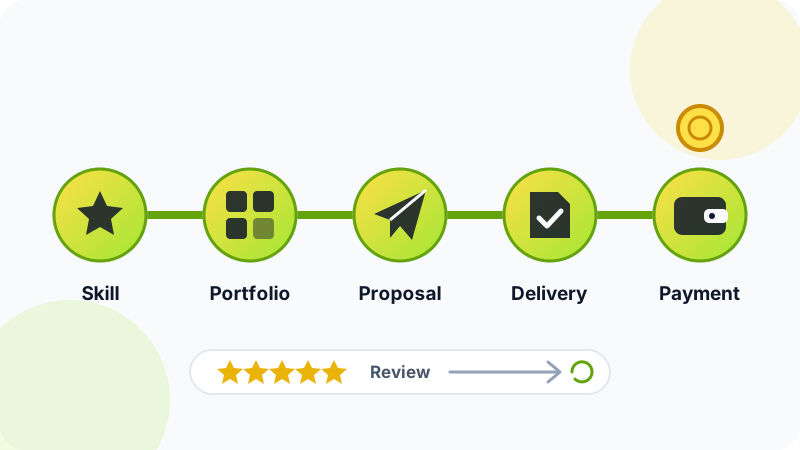
Freelancing means selling a skill, such as writing, design, translation, programming or video editing, to clients per project or per hour instead of working for one employer. You can start from zero by choosing one skill, building a few portfolio samples, creating a profile on a platform such as Upwork, Fiverr or the Arabic platform Mostaql, and sending clear, specific proposals to small projects.
In short: pick one sellable skill, prove it with 3 to 5 samples, start on one or two platforms, price modestly but never for free, communicate well, and expect the first months to be slow.
What freelancing is, and what it isn't
As a freelancer you are a small business of one. You find clients, agree on the scope and price, deliver the work and get paid. There is no fixed salary, no paid leave and no manager planning your week.
That brings real benefits: you choose your projects, you can often work from anywhere, and you can grow your income by improving your skills and reputation. It also brings real costs: income goes up and down, you handle your own taxes, and you spend unpaid time looking for work.
Be wary of anyone who sells freelancing as quick, easy money. It is a job like any other, and most people build it gradually, often alongside studies or a full-time job.
Choose one skill you can sell
Clients pay for results, not for general knowledge. Ask yourself: what can I already do well enough that someone would pay for it this month? Common starting points:
- Writing and content: articles, product descriptions, social media posts.
- Translation: Arabic and English is a useful pair in many markets.
- Design: logos, social media graphics, presentations.
- Programming: websites, small scripts, bug fixes.
- Video and audio: editing, subtitles, voice-over.
- Admin support: data entry, spreadsheets, research, inbox management.
Start narrow. "I design social media posts for restaurants" is easier to sell than "I do design", and you can widen your offer later. If you want ideas that combine your skill with AI tools, read AI skills that freelancers can sell.
Build a small portfolio before your first client
A new profile with no reviews competes against people with hundreds. Your portfolio is what closes that gap.
- Create 3 to 5 samples of the exact kind of work you want to be hired for.
- If you have no clients yet, make realistic practice projects: redesign a local shop's menu, write a sample blog post, translate a public-domain text.
- Don't use a real company's name or logo in a way that suggests they hired you. Label practice work honestly as a sample or concept.
- Put the samples somewhere easy to open: the platform's portfolio section, a simple website, a PDF, or GitHub for code (see our Git and GitHub guide).
- Add one or two lines to each sample explaining the problem and what you did.
Quality beats quantity. Three excellent samples do more for you than twenty average ones.
Where to find work: the main platforms
| Platform | How it works | Good fit for |
|---|---|---|
| Upwork | Clients post jobs and you send proposals; hourly and fixed-price contracts | Longer projects in development, writing, design and support |
| Fiverr | You list packaged services and buyers order them | Clearly defined services: a logo, a video edit, a voice-over |
| Freelancer.com | Clients post projects and freelancers bid; some clients run contests | A wide range of small and medium projects |
| Mostaql (مستقل) | Arabic platform where clients post projects and freelancers submit offers | Arabic-speaking clients, Arabic content, translation, design |
| Khamsat (خمسات) | Arabic marketplace for small, fixed-scope services | Quick, well-defined tasks for Arabic-speaking buyers |
Mostaql and Khamsat are both run by Hsoub. All of these platforms take a fee from your earnings, and some charge for extras such as additional proposals or profile promotion. Fees and rules change, so read each platform's current fee and terms pages before you start.
Complete your profile properly: a clear photo, a specific headline, a short description focused on what you do for clients, and your best samples.
How to price your work as a beginner
There is no single right price, but a few principles help:
- Research first: see what freelancers at a similar level charge on the same platform.
- Quote per project when you can: clients understand "a five-page website for your clinic" more easily than an hourly rate, and you benefit from working efficiently.
- Start modestly, not free: a slightly lower price can help you win your first reviews. Free work tends to attract clients who don't value your time.
- Define the scope: write down what's included and how many revisions. Extra requests get a separate quote.
- Raise prices gradually: after a few good reviews, increase your rates for new clients.
Platform fees, withdrawal fees and exchange rates all reduce what actually reaches your account, so include them in your calculations.
Winning your first clients
Most beginners send generic, copy-pasted proposals and hear nothing back. A strong proposal is short and specific:
- Show you read the brief: mention one detail from the job post in your first sentence.
- Explain your approach: two or three lines on how you'll handle this particular task.
- Attach one relevant sample: an example that matches the job, not your whole portfolio.
- Ask one useful question: it shows interest and starts a conversation.
- Keep it brief: a client reading dozens of proposals will skim.
Apply to small, clearly described projects first. They are easier to win, and each finished project brings a review. Also tell the people around you: friends, former colleagues and local businesses are often a source of first work.
After delivery, politely ask for a review. Make the client's life easy: reply quickly, meet deadlines, and raise problems early rather than at the last minute.
Getting paid safely
On most platforms the client funds the project or milestone before you start, and the money is released to you when the work is approved. There is often a waiting period after that before you can withdraw. Withdrawal methods, such as bank transfer, PayPal or Payoneer, depend on the platform and on your country, so check what works for you before accepting work.
A few rules protect you:
- Keep payment on the platform. Most platforms forbid taking payment outside the platform from clients you met there, and breaking that rule can get your account closed. It also removes your protection if the client disappears.
- With direct clients, ask for a deposit before you start, and put the scope, price and deadline in writing, even in a simple email.
- Never pay to get work. A "client" who asks you to buy software, pay for training or send money first is almost certainly a scammer. Our guide on how to spot "make money online" scams covers the common tricks.
- Secure your accounts with a strong password and two-factor authentication, because they hold your earnings.
A realistic timeline
Freelancing usually grows slowly. The first weeks go into your profile and portfolio. The first client may come quickly, or it may take months of steady proposals. Income tends to become more stable only once you have repeat clients and a solid set of reviews.
Keep a simple spreadsheet of proposals sent, replies, projects and payments. It shows you what works, and it helps at tax time, since freelance income is taxable in many countries. Check the rules where you live.
Above all, don't leave a stable income until freelancing has covered your needs consistently for several months. Build it step by step, and over time your skills and reputation will do more of the selling for you.
Frequently asked questions
Can I start freelancing with no experience?
Yes, but you need one skill you can do reasonably well and a few samples that prove it. Clients rarely ask about degrees; they look at your portfolio, your reviews and how clearly you communicate.
How long does it take to get the first client?
It varies a lot. Some people land a small job within a few weeks, while for others it takes several months of steady proposals. Treat the first months as a learning period and keep your current income until freelancing is consistent.
Do I need to pay to join a freelancing platform?
Creating a basic account on the major platforms is free. Some charge for extras, such as sending more proposals, and all of them take a fee from your earnings. Be wary of any 'agency' that asks you to pay upfront to get work.
Is it better to work on one platform or several?
Start with one or two so your reviews build up in one place; a handful of reviews spread across many sites carries less weight. Once work is steady, you can add another platform or look for direct clients.
Do I have to pay tax on freelance income?
In many countries, yes. The rules differ by country and by amount, so check with your local tax authority or an accountant, and keep a record of every payment you receive.
Related tutorials
Earning online
AI Skills Freelancers Can Sell: 6 Services and How to Deliver Them Well
Six AI-assisted services freelancers can offer, from writing and images to chatbots and automation, plus how to be honest with clients and check quality.
· 6 min read
Earning online
How to Spot 'Make Money Online' Scams and Protect Yourself
Learn the warning signs of online money scams, from upfront fees and guaranteed returns to fake jobs and task apps, and how to check offers and report fraud.
· 6 min read
Earning online
How to Make Money From Your Website With Google AdSense
How Google AdSense works, what RPM and CPC mean, how to get your site approved, which pages and policies matter, and why earnings take months to grow.
· 6 min read